

Reflecting Objectives
Reflecting objectives have the following advantages when compared to standard refracting microscope objectives:
- Longer working distances relative to the magnification.
- Large numerical apertures for improved light gathering power.
- High throughput from UV to far infrared.
- Custom tube lengths.
- Cover glass correction.
- Coatings available to enhance performance at specific wavelength regions.
Reflecting objectives have the following advantages when compared to standard refracting microscope objectives:
Our reflecting objectives offer:
Further Information
Because there are no refracting elements and no cement in the optical path, reflecting objectives have two further advantages:
- Zero chromatic aberration. Focus position is identical at every wavelength, so one objective serves UV, visible and IR on the same instrument with no refocus between bands. Spherical aberration, coma and astigmatism are corrected through mirror curvature and separation, and every model is specified at λ/4 peak-to-valley or better, the Rayleigh diffraction-limited criterion, and λ/14 RMS at 633 nm.
- High power handling. No bulk absorption and no thermal lensing in the glass, because there is no glass. Coating choice governs the power limit.
Any standard model can be fully customised, or we can build to a prescription of your own. All reflecting lens objectives from Beck Optronic Solutions are compliant with RoHS directives 2002/95/EC, 2011/65/EU and 2015/863.
Request a quotation/send us your optical prescription or email us at info@beckoptronic.com
Property | Beck Optronic Solutions Model No | |||||
5001 | 5002 | 5003 | 5004 | 5006 | 5007 | |
Magnification | x15 | x15 | x25 | x36 | x52 | x74 |
Numerical aperture | 0.28 | 0.50 | 0.40 | 0.50 | 0.65 | 0.65 |
Focal length (mm) | 13.35 | 13.41 | 8.00 | 5.41 | 3.55 | 2.54 |
Visual FOV (mm) | 1.20 | 1.20 | 0.72 | 0.50 | 0.34 | 0.24 |
Obscuration | 25.0% | 21.5% | 22.5% | 13.0% | 17.5% | 15.0% |
Transmitted wavefront error | ≤λ/4 P-V, λ/14 RMS @633 nm | |||||
Working distance (mm) | 24.5 | 23.2 | 14.5 | 8.6 | 1.8 | 1.0 |
Small mirror diameter (mm) | 7.30 | 13.40 | 6.30 | 5.60 | 4.60 | 3.35 |
User adjustment for tube-length and cover glass thickness | Fixed (factory set) | Fixed (factory set) | Fixed (factory set) | Yes | Yes | Yes |
Range of cover glass thickness (mm) | 0 – 3.0 | 0 – 3.0 | 0 – 3.0 | 0 – 1.0 | 0 – 1.0 | 0 – 1.0 |
Range of tube-length (mm) | 80 - ∞* | 80 - ∞* | 80 - ∞* | 90 - ∞ | 120 – ∞ | 120 - ∞ |
*Factory set for one cover glass thickness and one tube length. To be specified at the time of ordering | ||||||
Choosing a Model
Two 15x options, both with over 23 mm of working distance
- 5002 at 0.50 NA for maximum light gathering and resolution. Select this model where signal or resolution is the limiting factor
- 5001 at 0.28 NA for greater depth of field and the longest working distance in the range at 24.5 mm. Choose the 5001 where you need to hold a thicker or uneven sample in focus, or where space around the sample is tight.
Lowest obscuration: 5004. At 13.0%, the best in the range, and the strongest choice for laser delivery, where obscured pupil area is lost power. Combined with 0.50 NA at 36x.
Working distance by application. 24.5 mm at 15x and 14.5 mm at 25x give generous clearance for windows, cryostats and fixtured parts. Working distance in a reflecting objective is set by the optics, not by the packaging: at a given magnification the secondary mirror sits where the design requires it to sit, and its substrate thickness, support and stray light mask occupy part of the space in front of it. The figures in the table are therefore close to the most the geometry allows and greater clearance is achieved therefore with lower magnification. 5006 and 5007 are close-coupled designs delivering 0.65 NA at high magnification, at 1.8 mm and 1.0 mm respectively. Please check that against your sample mount before specifying, and talk to us early if the clearance looks marginal.es are supplied with aluminium coated mirrors. This gives the widest spectral coverage from UV to far IR, but limits the objective to low power use only. In applications requiring high power, Beck offers alternative coatings as detailed below. For specialised applications we can provide other specialist coatings.
Coatings
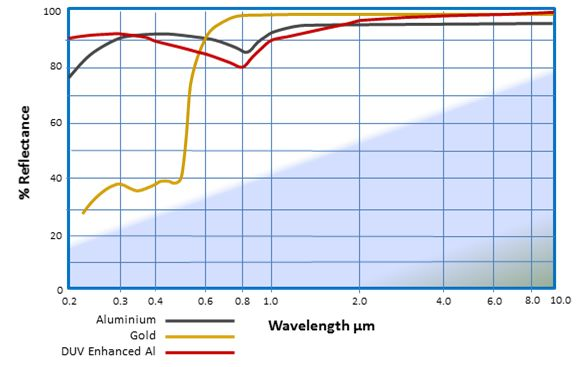
Standard objectives are supplied with aluminium-coated mirrors, giving the widest spectral coverage but restricted to low power use. Three alternatives are listed, and other specialist coatings are available to order.
Range | Reflectance | Coating | Suffix |
250 nm to 10 µm | 89.0% average | Aluminium | -000 |
190 nm to 10 µm | >89.0% | DUV enhanced aluminium | -190 |
450 nm to 20 µm | >97.0% to 2 µm | Silver | -150 |
700 nm to 15 µm | 98.0% | Gold | -120 |
Gold is the choice for infrared and high-power work at 98.0% reflectance. Silver runs from the visible out to 20 µm, the longest wavelength we coat for, and is the natural choice for an instrument that has to work in the visible and the infrared without changing objective. DUV enhanced aluminium reaches 190 nm while keeping full 10 µm long-wave coverage, the widest single continuous band on offer.
Spider Geometry
The secondary mirror is held by a spider, and the number of legs affects both how much light is diffracted and where it goes. Three legs is standard and produces the least diffracted energy, spread into a six-point flare pattern. Four legs diffract more in total but concentrate it into a four-point pattern with wider clear gaps between the spikes, which some users prefer. Three legs are supplied as standard; add postfix 4 to the part number for four.
Back Reflections
The secondary mirror sits on axis and faces the incoming beam, so a portion of it can be returned straight back up the optical path. Where that matters, two options are available.
- A matt black dimple can be ground into the secondary mirror to break up the return. Add postfix -D to the part number.
- A clearance hole through the secondary mirror is also possible, allowing the beam to pass rather than be reflected. This is not a standard option, so contact us to discuss what can be done for your configuration.
For laser delivery, laser drilling and etching, marking, and pumping, where a return into the source is a risk to the source rather than just a nuisance in the image, then either option is worth considering.
Ordering
Part number is model, then coating suffix: a 36x objective with gold mirrors is 5004-120. A 52x with silver mirrors is 5006-150. For a four-legged spider, add 4 to the end of the coating suffix: the same 36x gold objective becomes 5004-1204, and the 52x silver becomes 5006-1504. For 5001, 5002 and 5003, also specify tube length and cover glass thickness, as both are set at the factory.
Build to Order
Every standard model can be fully customised. We quote as routine work: magnification above 74x; tube lengths and conjugates outside the standard ranges; window correction for cryostat, vacuum or pressure windows, designed in and factory set; coatings beyond the four standard listed; and mechanical interface, meaning thread, barrel diameter, parfocal length and flange geometry to your drawing.
Retrofit and legacy support: Because we build to prescription as well as to standard (COTS) and modified (MOTS), we can supply modern objectives to legacy mechanical and optical interfaces, including fitting current mirror sets into existing barrels where the instrument is worth preserving. Send us the part number and any drawings you hold.
Applications
- Laser drilling and etching.
- Product marking
- Laser pumping.
- Thermal imaging microscopy
- Semiconductor and photomask inspection.
- UV and DUV photolithography.
- Raman and FTIR microspectroscopy.
- Forensic and materials microscopy.
"We are doing critical work with the 74x IR objective, imaging down to about 3 microns using a mid-wave IR camera. It is very exciting what we can do with these units."
Tom Perisco, Advanced Spectral Technology
Capability
Beck has been designing and manufacturing opto-mechanical systems for scientific and technological applications since 1839 and reflecting objectives for over 60 years. We are one of a handful of manufacturers worldwide still these lenses. Design, mirror figuring, coating specification, alignment and interferometric test are all carried out in-house. That is why non-standard conjugates, window corrections and bespoke spider geometry are quoted as routine work rather than special projects.
What We Need in Order to Quote
- Magnification or target resolution.
- Wavelength range and whether high power.
- Tube length and cover glass thickness.
- Any window in the path.
- Working distance and clearance constraints.
- Spider preference.
- Mechanical interface or drawing.
Partial information is enough to start. Request a quotation
Notes: If back reflections may be an issue in your application a matt black dimple can be ground into the secondary (smaller) mirror. Add postfix -D to the part number.
If you require a clearance hole through the secondary mirror please contact us to discuss the options available.
Please visit our Technical Data page for interface drawings, user manuals etc
Distributors for Reflecting Objectives
France, Belgium, Luxembourg and The Netherlands




Optoprim
TEL +33 (0) 1 41 90 61 80
EMAIL info@optoprim.com
Germany, Austria and Switzerland



Mountain Photonics
TEL +49 (0) 8191 985199-01
EMAIL info@mphotonics.de
Italy

Optoprim
TEL +39 (0) 39 834977
EMAIL info@optoprim.it
Japan

Koyo
TEL +81 (0) 3 3213 1571
EMAIL sales@koyo-opt.co.jp
South Korea

Westpac
TEL +82 31 273 2361
EMAIL info@westpac.co.kr / indi.hong@westpac.co.kr
USA

ON-TRAK Photonics
TEL +1 (0) 949 587 0769
EMAIL info@on-trak.co
People's Republic of China

Beijing Zhongtuo Huijie Technology
TEL +86 (0) 431 86176312
EMAIL condor_ms@163.com
Shanghai Kingdom Intelligent Technology
TEL +86 (0) 177 49736200
EMAIL techservice@kingdom-sh.com
Guangzhou Viewsitec Technology Co., Ltd
TEL +86 (0) 18124130753
EMAIL sales@viewsitec.com
Shenzhen YunWay Tech Co. Ltd
TEL +86 (0) 185 2019 0828
EMAIL michael.yan@cloudsway.net.cn
India

Medi Analytika
TEL +91 (0) 44 2446 3084
EMAIL info@medianalytika.com
Worldwide, non-exclusive: www.bestscientificweb.com
Frequently Asked Questions
Which 15x should I choose?
5002 at 0.50 NA for light gathering and resolution; 5001 at 0.28 NA for greater depth of field, a smaller secondary and 24.5 mm working distance.
Can you match my existing tube length?
Yes, from 80 mm to infinity depending on model. Specify it when ordering 5001 to 5003; user adjustable on 5004, 5006 and 5007.
Working through a cover glass? 0 to 3.0 mm on 5001 to 5003, 0 to 1.0 mm on 5004, 5006 and 5007. Thicker or non-standard windows quoted as a custom correction.
Shortest wavelength?
190 nm, with DUV enhanced aluminium, suffix -190.
Longest wavelength?
20 µm, with silver, suffix -150. Gold reaches 15 µm.
Can I have more working distance at high magnification?
Not to any useful degree. The secondary mirror has to sit where the design puts it, and its thickness, support and stray light mask take up part of what is left. Working distance and magnification trade against each other, so if you need clearance, the answer is a lower magnification: 15x gives 24.5 mm, 25x gives 14.5 mm.
What about high-power laser use?
Gold-based objectives, with 98.0% reflectance are the usual choice rather than standard aluminium, which is specified for low power. Tell us power and wavelength.
How much light reaches my detector?
This depends on your coating, wavelength and the obscuration of the model. Tell us your configuration and we will give you a figure for it.
Higher NA than 0.65?
Not in the standard range. Tell us the resolution you need and we will advise whether a custom design can reach it.
Do you offer magnification above 74x?
Yes, built to order.
Minimum order quantity?
One